What Can You Eat To Lose Weight?
Is it really food?
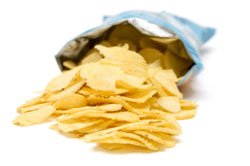
I was seeing patients in the hospital and one of the guys that worked there held up a bag. He held it up and he said, "Look at this, a dollar for a bag of food."
And I couldn't believe the words coming out of his mouth. Here was this guy, nicest guy you'd ever meet and otherwise a bright guy, holding up a bag of potato chips and calling it a bag of food.
Is that really food? Potato chips are not really potatoes. No, they are grease and salt. The potato part is just a grease holder.
Amazingly enough, if you look at it and add it up, potato chips are greasier than French fries, if you can imagine anything could be greasier that something that is basically just a freshly boiled hot grease holder.
But to him that was "a bag of food." Well, it wasn't a bag of food to his body. To him the chips were fat pills. He didn't eat to lose weight. He ate to gain weight.
He was 150 pounds (68 kg) overweight and getting worse all the time. To his body it was just more calories, more fat, less metabolism and one step closer to death. And I am sure he had no slightest idea what he was eating. Or even the idea that it mattered.
But it does matter. If you do not know what your food is made of I can guarantee that you will eat the wrong things in the wrong amounts and you will definitely and always remain overweight. So this you have to know.
Diet and successful weight loss
If you want to lose weight you must know what it is that you are eating. Simple but true.
Food is made up of something. And when you are trying to lose weight this is a critical point. Why? Because your body reacts differently to foods of different composition.
Where one food might give you a spike in your blood sugar but then lead to a crash, another might stimulate the processes of growth and metabolism.
So what is your food made of? Every time you put something in your mouth you should know the answer to that question. What is it made of? This is how you eat to lose weight, not gain weight.
Food is made of...
For all intents and purposes, there are only three things that food can be made of. They are:
- protein
- fat
- and carbohydrate (sugar)
That's not a big list. Just three things. You might have thought it was more complicated.
You might say, "But that's not right. Food also has vitamins. And minerals. And I drink orange juice because it has vitamin C in it."
Well, that's right. Food has all those vitamins and minerals and vitamin C and iron, copper, zinc, and on and on.
Example: a trace mineral
Let's take zinc as an example. Zinc is a metal actually. You know, like the metal your car is made of.
Only in food there are tiny bits of zinc. And you need zinc so your body can grow and heal and take care of itself. So you've got to have zinc. And there is zinc in your food.
But how much zinc? You need about 20 milligrams of zinc each day in your diet. You know how much that is?
Imagine you had a nickel (a small coin in the United States) and it was made of zinc. And you had a little knife. And you cut that nickel into 250 pieces. See, 250 little pieces of zinc from that one nickel.
And you took just one of those little, tiny pieces of that nickel that are too small for you to see. You couldn't even see it with a magnifying glass it is that small. That is about 20 milligrams of zinc. That is how much zinc you take in every day.
The same thing with the vitamins. The other minerals. There are just these little tiny amounts.
But the structure of your food -- the big stuff -- is protein, fat and carbohydrate.
What's important. And what's not.
Your body is not made of vitamin C. You need it for tissue repair and strong joints and blood vessels. But it is not really made of vitamin C.
Did you ever drink some juice "because it has vitamin C"? Well, if you did... bad choice. Because when you are trying to lose weight the vitamin C in orange juice doesn't matter. See, a lot of calories for a little vitamin C. It just doesn't add up.
It's not just a saying: you really are what you eat
But your body is made of fat and protein and carbohydrate. You eat these in large amounts. You eat these by the mouthful. These are where the energy is. These are where the calories are. And if you gain weight it has to come from somewhere, and this is where it comes from.
There are no calories in vitamins. There are no calories in minerals. But there are calories in proteins, carbohydrates and fats.
So you need to know what is in the food you are eating.
- You have to know how much fat you are eating.
- You have to know how much carbohydrate you are eating.
- You have to know how much protein you are eating.
And if you do figure this out -- if you do know and understand this for food in general and specifically for those things you eat most often -- then you have an excellent chance to take off those extra pounds.
Popular articles:
With weight loss, knowledge is power...
If you know these few truths on this page -- and if you apply them consistently in your life...
If you can't stay on it forever and be fit and healthy and strong -- then it's an extreme diet.
Here's the easy way to ruin any slightest chance you have of losing weight...
Can you eat in restaurants and still respect yourself in the morning?
Calorie density is the difference between vegetable soup and a bagel.
Hidden calories that ruin your waistline...
Will it really help to drink water to lose weight?